February 13, 2024 — RapidAI, the global leader in developing Artificial Intelligence (AI) and clinical workflow solutions to combat life-threatening neurovascular, cardiac, and vascular diseases, today announced the publication of the TIMELESS trial in the New England Journal of Medicine (NEJM). Other select data from research studies unveiled last week at the American Heart Association’s International Stroke Conference (ISC) underscore and reinforce the pivotal role of the RapidAI platform in advancing stroke care.
Data Summaries from Key Studies:
Subgroup Analyses from the TIMELESS Trial, by Gregory Albers, M.D., presented and simultaneously published in the NEJM.
- The TIMELESS trial compared tenecteplase (TNK) with placebo in later window patients (>4.5h from symptom onset up to 24 hours) with a Large Vessel Occlusion (LVO) since last known well (LKW).
- Rapid CT Perfusion (CTP) and Rapid MRI Perfusion Maps were leveraged for all patient selection.
- Key imaging criteria: target mismatch ratio of ≥1.8, mismatch volume of ≥15 mL, and ischemic core volume <70 mL for study inclusion based on RapidAI software.
- TIMELESS is the first study to show that an intravenous thrombolytic can be given up to 24 hours after LKW without an increase in brain hemorrhage.
- Clinical outcomes were not significantly different, but encouraging subgroups (such as patients with an occlusion of the proximal MCA or treated at spoke sites prior to transfer for thrombectomy) have been identified for future studies.
Detecting MeVOs and Collateral Assessment with Multimodality AI Approach, by Sowlat et. al.
- Of 149 patients whose scans were retrospectively analyzed, 27.3% of medium-vessel occlusions (MeVOs) were successfully identified by Rapid LVO alone, and another 25.3% by Rapid Vessel Density Maps, for a total of 52.6% of MeVOs identified by the two combined. This signals the potential benefit of using Vessel Density Maps to flag MeVO patients for review at centers without CTP capabilities.
- 93.3% of MeVOs were identified when utilizing Rapid LVO + CTA + CTP.
Improved Stroke Outcomes Following Implementation of RapidAI Platform at Ascension-Illinois, by Malisch et. al.
- Based on data from the Get With The Guidelines® Stroke database, 1,732 patients with arterial ischemic stroke (AIS) were analyzed to compare findings before and after the implementation of RapidAI.
- Data showed a median reduction of 30 minutes per patient from door-to-mechanical thrombectomy (MT) after the integration of RapidAI.
- Post-RapidAI, there was a 51% increase in MT procedure volume from 9.6% to 14.5%.
- RapidAI was associated with a significant improvement in the workflow for MT procedures as evidenced by reduced door-to-femoral puncture times and improved discharge Modified Rankin Scores.
National database demonstrates substantial delays between non-contrast CT and CT angiography in suspected stroke patients in 2023, by Christina Mijalski Sells, M.D., and, Pina Sanelli, M.D. MPH, FACR.
- Data on 23,935 patients from 717 U.S. hospitals using CT and CT angiography (CTA) were processed with RapidAI to determine time delays between the modalities.
- 18% of all patients had a more than 15-minute delay between NCCT and CTA, and 6% had a more than 30-minute delay.
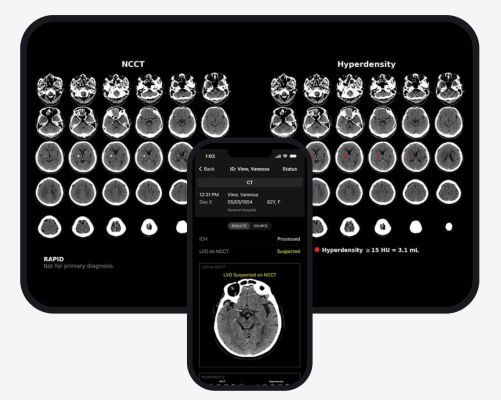
- Even among high-performing hospitals, many patients had a >15-minute delay between modalities – reaffirming the potential operational and clinical value of Rapid’s NCCT suite in identifying LVOs on NCCT scans and substantially reducing door-to-diagnosis time.
Three subacute or chronic subdural hematoma (SDH) studies, EMBOLISE, MAGIC-MT, and STEM, were also reported at ISC; all showed positive results demonstrating a reduction in recurrence of the subdural when embolization of the middle meningeal artery (MMA) was used in addition to surgery versus surgery alone. SDH is one of the most common neurosurgical diseases and affects 1-21 per 100,000 patients per year, and the rate of recurrence requiring treatment is 12-20%.,, Many SDH patients are lost to follow-up. Proper identification and tracking of SDH through technology such as Rapid SDH will be beneficial in identifying patients most suitable for MMA procedures.
“In the world of AI, clinical validation is paramount to instill confidence in clinician decision-making,” said Karim Karti, CEO of RapidAI. “Securing another NEJM publication and sharing results from more than a dozen studies at ISC 2024 reaffirms our lasting and ongoing contribution to enhancing stroke care.”
For more information: www.rapidai.com
 September 02, 2026