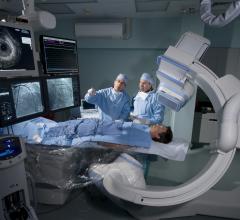
April 20, 2009 - The University of Ottawa Heart Institute (UOHI) has installed North America's first dual axis rotational cardiac X-ray for clinical use, allowing physicians to more clearly locate and diagnose blockage in the heart's arteries.
The equipment cuts radiation exposure by 33 percent, reduces X-ray time by a similar amount and offers other benefits.
"The Heart Institute typically conducts 6,000 catheterizations each year and we can further decrease the waiting period for our heart patients", said Marino Labinaz, M.D., director, cardiac catheterization laboratory, UOHI. "As part of our research mandate, we are also planning to investigate the full impact of this advanced X-ray technology on patient risk and improved effectiveness."
Diagnosing coronary blockage through a procedure called cardiac catheterization is traditionally performed by taking six or seven different X-ray views. In each case, dye is injected into the coronary artery. Each injection takes time - to set up and to make the injection. With the new rotational X-ray, only one injection is needed to cover all views, requiring up to 20 per cent less dye. This is significant because the dye can cause potential damage in patients with kidney problems.
The new X-ray system quickly rotates around the patient, giving medical teams the ability to more easily view live 3D images of the arteries in a manner that improves the quality of diagnosis and treatment. In turn, this approach reduces the length of the procedure - leaving more time for other patients and helping to boost patient throughput. The advanced nature of the equipment also lowers the amount of radiation required to image the arteries by up to 33 percent, helping to reduce potential radiation risks for patients.
The X-ray system is part of a new generation of imaging equipment that provides patients at the Heart Institute with improved accuracy and speed in the diagnosis and treatment of coronary artery disease. The Heart Institute is the first clinical site in North America and one of a handful of cardiac catheterization facilities in the world to employ the dual axis rotational X-ray.
"Patients at the Heart Institute continue to benefit from the most advanced practices, technologies and treatments in coronary artery disease," said Dr. Labinaz. "As this technology gets adopted elsewhere, our research knowledge and experience will reduce the learning curve for other clinical centers which, in turn, will benefit patients across the country."
For more information: www.ottawaheart.ca/UOHI/Research.do
 October 24, 2025