Technology | Radiation Dose Management | May 23, 2019

ControlRad Announces FDA Clearance and Launch of ControlRad Trace

Radiation reduction technology integrates directly into mobile C-arms

ControlRad Announces FDA Clearance and Launch of ControlRad Trace

May 23, 2019 — ControlRad Inc. announced that the U.S. Food and Drug Administration (FDA) granted 510(k) clearance for its ControlRad Trace and the company has initiated its commercial launch. The ControlRad Trace is the only technology, according to the company, that can be integrated into existing mobile C-arms to reduce radiation in any fluoroscopic imaging procedure.

“Radiologists and our teams have grave concerns about the long-term effects from radiation exposure,” said John A. Carrino, M.D., MPH, vice chairman of radiology, Hospital for Special Surgery. “I am excited that new technology for mobile C-arms is now available because it has the potential to drastically improve our radiation safety while maintaining image quality so we can continue to effectively diagnose and treat our patients. I believe these new products should become the standard of care for fluoroscopic procedures.”

Fluoroscopically guided procedures (FGP) with C-arms have allowed for major advances in treating countless diseases. However they expose patients and medical staff to ionizing radiation, which may increase a person’s lifetime risk of developing cancer.1 For example, an interventional fluoroscopy procedure is roughly equivalent to the adult effective dose of between 250-3,500 chest X-rays.2

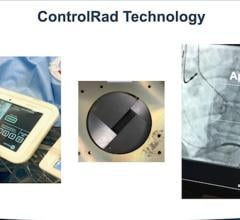
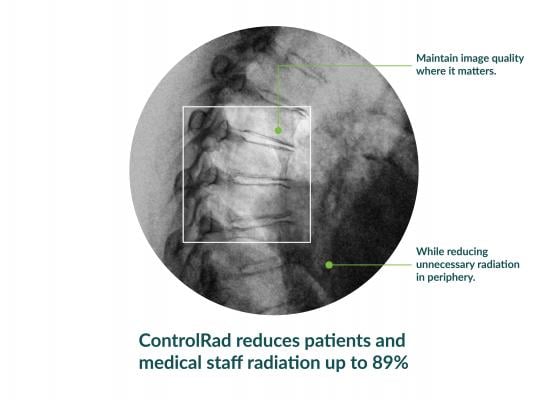
With its proprietary semi-transparent filter, tablet and image processing technology, the ControlRad Trace solution can be retrofitted on existing C-arms, reducing the barrier to adopting the technology in order to reduce unnecessary radiation up to 89 percent,3 without compromising image quality in the region of interest (ROI) and overall workflow. The medical staff draws an ROI on a ControlRad tablet, which in real time optimizes image quality in the ROI while reducing unnecessary radiation in the periphery.

For more information: www.controlrad.com

References

1. https://www.fda.gov/radiation-emitting-products/initiative-reduce-unnecessary-radiation-exposure-medical-imaging/white-paper-initiative-reduce-unnecessary-radiation-exposure-medical-imaging, p. 1

2. Ibid, p. 3

3. Data on file


Related Content

News | Radiation Dose Management

May 20, 2025 — Royal Philips has launched the RADIQAL (Radiation Dose and Image Quality Trial) trial. This multicenter ...

Home May 20, 2025
Home
News | Radiation Dose Management

May 7, 2024 — HonorHealth Research Institute’s David G. Rizik, M.D., narrates and is a co-producer of a documentary ...

Home May 07, 2024
Home
News | Radiation Dose Management

June 17, 2022 — A multidisciplinary team of robotics and electronic systems engineers working with cardiologists and ...

Home June 17, 2022
Home
Videos | Radiation Dose Management

The vendor Radiaction introduced a new type of scatter radiation protection shielding system that mounts to the ...

Home December 10, 2021
Home
Videos | Radiation Dose Management

Dr. Simon Dixon, MBChB, chair of the Department of Cardiovascular Medicine at Beaumont Hospital Royal Oak, the Dorothy ...

Home November 17, 2021
Home
News | Radiation Dose Management

November 5, 2021 – An FDA-approved device used during cardiac cath lab procedures cut radiation exposure for ...

Home November 05, 2021
Home
Feature | Radiation Dose Management | Dave Fornell, Editor

More than a decade ago, there was an alarming, rapid rise in ionizing radiation exposure in the U.S. population that was ...

Home November 04, 2020
Home
News | Radiation Dose Management

July 21, 2020 — Interventional cardiology is ranked as the occupation with the highest level of radiation exposure in ...

Home July 21, 2020
Home
Videos | Radiation Dose Management

Mahadevappa Mahesh, Ph.D., chief of medical physicist and professor of radiology and medical physics, Johns Hopkins ...

Home December 19, 2019
Home
News | Radiation Dose Management

July 18, 2019 — Low doses of radiation equivalent to three computed tomography (CT) scans, which are considered safe ...

Home July 18, 2019
Home
Subscribe Now