News | EP Lab | July 29, 2021

Oral Anticoagulants After Catheter Ablation Helps Reduce Stroke in High-Risk Patients

Results show use of blood thinners is more effective when compared to aspirin for patients undergoing left atrial catheter ablation

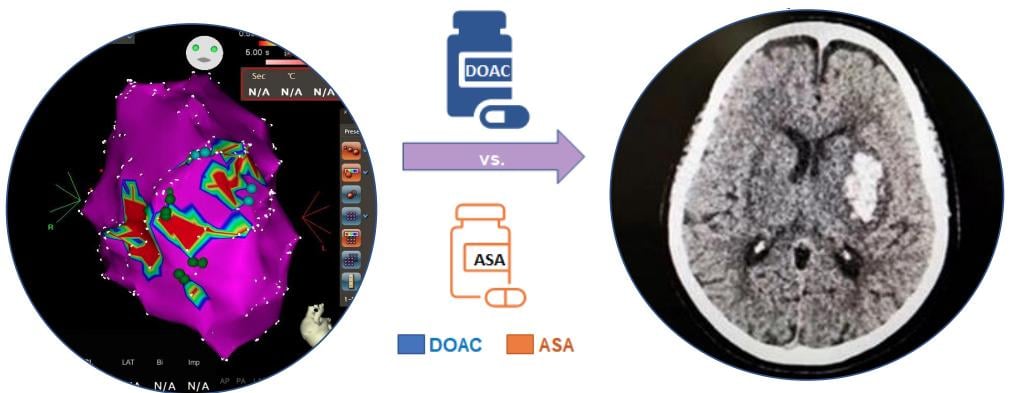
Results of the STROKE-VT trial showed direct oral anticoagulants (DOACs) are more effective than aspirin in reducing cerebrovascular events, including stroke in patients undergoing ventricular tachycardia ablation.

Results of the STROKE-VT trial showed direct oral anticoagulants (DOACs) are more effective than aspirin in reducing cerebrovascular events, including stroke in patients undergoing ventricular tachycardia ablation.


July 29, 2021 – Results of the STROKE-VT trial shows direct oral anticoagulants (DOACs) are more effective than aspirin in reducing cerebrovascular events, including transient ischemic attack and stroke in patients undergoing ventricular tachycardia using radiofrequency catheter ablation (RFA). The data were presented as a late-breaking clinical trial as part of Heart Rhythm 2021, the annual meeting for the Heart Rhythm Society (HRS).

Catheter ablation is an established treatment for patients with atrial fibrillation (AF), the most common heart rhythm disorder. However, stroke and thromboembolism are known complications of left atrial (LA) catheter ablation, a procedure performed for those with symptomatic AF.[1] Left LA catheter ablation has a stroke risk of approximately 0.5 to 1%.[2] It has been shown within the electrophysiology (EP) field that when ablation procedures are conducted without anticoagulants (AC), patients are at an increased risk of stroke,[3] but the effect on anticoagulation for left ventricle procedures is understudied.

“The STROKE-VT trial helps us answer a longstanding question around the best way to lower procedure-related risks for patients coming out of an ablation,” said Dhanunjaya R. Lakkireddy, M.D., FHRS, executive medical director of the Kansas City Heart Rhythm Institute and lead author of the STROKE-VT study. “Moving forward, we hope the findings encourage electrophysiologists to use anticoagulants after ablations to reduce cerebrovascular events in a patient population that is already very sick and at high-risk of stroke.” 

The study enrolled a total of 246 patients across four centers scheduled for left ventricular arrhythmia (LVA) RFA. Patients were randomized to receive either DOAC using apixaban (Eliquis) or aspirin (ASA) following their procedure which was then administered three hours after hemostasis. A brain MRI was conducted within 24 hours and at 30 days and neurological changes were assessed before, after, and at 30 days follow-up based on the National Institutes of Health NIH stroke scale.

Findings show significantly lower procedure-related complications in the DOAC arm than the ASA arm (3.7% vs. 24%; p<0.001). The rates of post-procedure cerebral vascular events (CVE) were lower in the DOAC arm compared to the ASA arm (4.5% vs. 19.6%, p<0.001 and 0 vs. 7.1%, p<0.001; respectively). At both 24 hours and 30 days, asymptomatic CVE on MRI were lower in the DOAC arm compared to the ASA arm (11.2% vs 25%, p=0.006 and 6% vs 19.6%, p=0.001; respectively).

The study was conducted at the Kansas City Heart Rhythm Institute in collaboration with Bristol-Myers Squibb.

Find additional HRS 2021 late breaking trials

Find more EP device news

Find more HRS 2021 conference news


References: 
1. Forleo, G. B., Della Rocca, D. G., Lavalle, C., Mantica, M., Papavasileiou, L. P., Ribatti, V., Panattoni, G., Santini, L., Natale, A., & Biase, L. D. (2016, February 29). A Patient With Asymptomatic Cerebral Lesions During AF Ablation: How Much Should We Worry? Journal of Atrial Fibrillation. https://www.ncbi.nlm.nih.gov/pmc/articles/PMC5089485/.

2. Haeusler, K. G., Karl Georg Haeusler From the Department of Neurology (K.G.H., Kirchhof, P., Paulus Kirchhof From the Department of Neurology (K.G.H., Endres, M., Matthias Endres From the Department of Neurology (K.G.H., Davis, S. M., & Al., E. (2011, December 8). Left Atrial Catheter Ablation and Ischemic Stroke. Stroke. https://www.ahajournals.org/doi/10.1161/STROKEAHA.111.627067.

3. Freeman, J. V., James V. Freeman James V. Freeman, Shrader, P., Peter Shrader Duke Clinical Research Institute, Pieper, K. S., Karen S. Pieper Duke Clinical Research Institute, Allen, L. A., Larry A. Allen Division of Cardiology, Chan, P. S., Paul S. Chan Saint Luke’s Mid America Heart Institute, Fonarow, G. C., Gregg C. Fonarow UCLA David Geffen School of Medicine, Gersh, B. J., Bernard J. Gersh Mayo Clinic, Kowey, P. R., Peter R. Kowey Lankenau Institute for Medical Research, Mahaffey, K. W., Kenneth W. Mahaffey Stanford University School of Medicine, Naccarelli, G., (2019, December 13). Outcomes and Anticoagulation Use After Catheter Ablation for Atrial Fibrillation. Circulation: Arrhythmia and Electrophysiology. https://www.ahajournals.org/doi/10.1161/CIRCEP.119.007612. 


Related Content

News | HRS

April 24, 2026 — The Heart Rhythm Society has announced the first analysis of its Centers of Excellence Optimal ...

Home April 24, 2026
Home
News | HRS

April 23, 2026 — A new study analyzing data from more than 13,000 patients found that people using the increasingly ...

Home April 23, 2026
Home
News | HRS

April 21, 2026 — At HRS 2026, Johnson & Johnson will launch the Cartosound Sonata Module, leveraging artificial ...

Home April 22, 2026
Home
News | HRS

July 30, 2024 — The Heart Rhythm Society (HRS) is preparing for HRX 2024, bringing cardiovascular health innovators to ...

Home July 30, 2024
Home
Feature | HRS | By Lars Thording, PhD

Innovation in medical technology exists to improve patient outcomes, increase surgical efficiency and enhance patient ...

Home June 11, 2024
Home
News | HRS

May 19, 2024 — A physician-initiated prospective, randomized clinical trial sponsored by the National Heart, Lung, and ...

Home May 18, 2024
Home
News | HRS

May 18, 2024 — The Heart Rhythm Society (HRS) has announced the findings of three new studies demonstrating the safety ...

Home May 18, 2024
Home
News | HRS

September 21, 2023 — Vektor Medical, developers of the only FDA-cleared technology to accurately map arrhythmias using ...

Home September 21, 2023
Home
Feature | HRS | By Melinda Taschetta-Millane

The Heart Rhythm Society (HRS) announced the full lineup of speakers and sessions, including late-breaking clinical ...

Home May 17, 2023
Home
News | HRS

May 2, 2023 — The Heart Rhythm Society (HRS) is making final preparations for its Annual Heart Rhythm Meeting, HRS2023 ...

Home May 02, 2023
Home
Subscribe Now