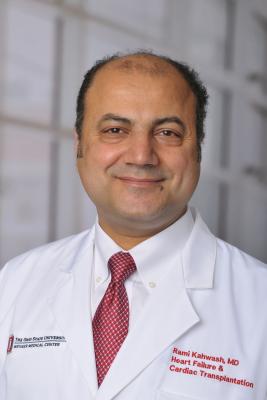
Dr. Rami Kahwash, director of Ohio State’s Heart and Vascular Research Organization and a professor of clinical medicine in the Ohio State College of Medicine.
December 9, 2022 — The Ohio State University Wexner Medical Center is first in the world to randomize a patient in a clinical trial confirming the clinical benefit of a device designed to treat diastolic heart failure. The first patient was randomized Thursday in the multicenter, prospective, randomized, double blinded study (RESPONDER-HF) at Ohio State’s Richard M. Ross Heart Hospital.
Diastolic heart failure (DHF) occurs when the heart muscle becomes stiff and does not relax enough to allow blood to flow from the lungs into the heart. This causes blood to back up in the lower left heart chamber, then the upper left heart chamber and into the lungs, causing shortness of breath.
“Despite ongoing pharmaceutical advances, treatment has remained challenging for those suffering from diastolic heart failure. Multiple therapeutic approaches are needed due to the several types of this syndrome. We are pleased to continue to be a leader in offering access to a novel treatment option that has the potential to relieve our patients’ breathlessness and improve their quality of life,” said Dr. Rami Kahwash, director of Ohio State’s Heart and Vascular Research Organization and a professor of clinical medicine in the Ohio State College of Medicine.
Ohio State was first in the world to randomize patients in the two prior clinical trials evaluating whether a dime-size implant relieved the high pressure and associated heart failure symptoms, created by blood backing up from the heart into the lungs.
During the procedure, doctors insert a catheter into a vein in the groin to access the heart. The catheter creates a small path between the left and right upper chambers of the heart. Doctors insert the tiny, inter-atrial shunt device to keep the path open to divert some of the blood from the high pressure left atrial chamber to the low-pressure right atrial chamber. This lowers pressure in the left upper chamber, decreasing pressure in the lungs and improving symptoms of heart failure for some patients.
“Results from the first two clinical trials showed promising signs in improving clinical outcomes for some of our patients. The current trial is designed to confirm these findings. We are excited to continue this journey as this novel device-based treatment could result in significant clinical benefit for millions of heart failure patients worldwide,” said Dr. Scott Lilly who performed the hemodynamic evaluation and randomized the first patient. He is an interventional cardiologist and director of the structural heart disease program at Ohio State.
Cecil Hamilton, 62, of Delaware, Ohio, participated in the pivotal trial at the Ross Hospital in October 2020. He had been diagnosed with congestive heart failure and was considering retiring on disability as a bus driver because of his breathlessness. Walking a block or showering left him short of breath.
“I was so short of breath that I couldn’t breathe. My water retention was horrible – I’d swell up like a balloon,” he said.
Even though the trial was randomized and he was blinded, Hamilton was sure he had the actual procedure, which was confirmed two years later when he was unblinded.
“Within days after the procedure I started feeling better and because doing daily activities was a lot easier, I got serious about losing weight. I’ve lost 70 pounds and gone off my diuretics medication, which was killing my kidneys. All of this was because of that one visit,” he said.
Heart failure is the world’s leading cause of hospitalization, affecting tens of millions worldwide and 6.2 million in the U.S. DHF accounts for about half of all heart failure cases, and risk factors include high blood pressure, diabetes, obesity and age.
“Ohio State has long been at the forefront of testing and offering new technologies to patients with heart failure. This device has the potential to dramatically change how diastolic heart failure is treated, and we are excited to enroll the first patient worldwide in the confirmatory trial, building on our successes in prior trials,” Kahwash said.
The Ross Heart Hospital will continue to recruit patients for the clinical trial. About 60 investigational sites in the U.S., Europe and Australia will take part, according to the device’s manufacturer, Corvia Medical Inc.
“I feel really honored to be part of the study. I would encourage anyone who has congestive heart failure to look into this. I don’t want to be overdramatic but this has changed my life,” Hamilton said.
For more information: https://wexnermedical.osu.edu/
 September 11, 2026