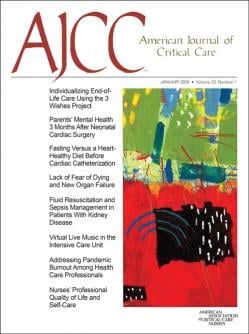
Credit: American Association of Critical-Care Nurses
January 4, 2024 — The days of prolonged fasting prior to cardiac catheterization may be numbered, as the body of evidence grows to allow patients to eat before the procedure.
Patients undergoing coronary artery catheterization are typically required to take nothing by mouth after midnight prior to their procedure, but there is no evidence to support this long-standing practice.
Building on evidence from several studies that found prolonged fasting may be unnecessary, a randomized, controlled trial at a Midwest heart hospital determined that allowing patients to eat a heart-healthy diet before elective cardiac catheterization posed no safety risk, while improving patient satisfaction and overall care.
A new study, “Fasting Versus a Heart-Healthy Diet Before Cardiac Catheterization: A Randomized Controlled Trial,” compared consumption of a heart-healthy, low-acid diet with standard fasting guidelines for patients in an inpatient cardiac unit undergoing elective coronary artery catheterization. The study is published in American Journal of Critical Care (AJCC).
The study was conducted at Parkview Heart Institute, Fort Wayne, Indiana, an 82-bed specialty hospital on the campus of Parkview Regional Medical Center.
“Requiring all patients to fast for six hours or longer has remained an anesthesia guideline for procedures requiring conscious sedation for decades,” said co-author Carri Woods, MBA, MSN, RN, a nursing manager at the hospital. “Our findings demonstrate that fasting isn’t necessary for every patient, and patient satisfaction and comfort can safely be put at the forefront of care.”
The convenience sample included 197 adult patients scheduled for elective cardiac catheterization with conscious sedation and analgesia. Patients were randomly assigned to one of two protocol groups, with 100 patients allowed to eat a specified diet of solid food low in fat, cholesterol, sodium and acidity until the scheduled procedure. The 97 patients in the fasting group were restricted to nothing by mouth, except for sips of water with medications, from midnight until the procedure, which was the hospital’s standard practice.
Data were collected before and after sedation and throughout postprocedural assessments. Patients also completed a satisfaction survey at discharge.
In the heart-healthy diet group, satisfaction with the preprocedural diet was significantly higher while thirst and hunger were lower.
No patients in either group experienced postprocedural pneumonia, aspiration, intubation or hypoglycemia. Fatigue, glucose level, gastrointestinal issues and use of loading dose of antiplatelet medication did not differ between the groups.
As a result of the study, the hospital has updated its protocols for inpatient and outpatient cardiology procedures to allow patients to eat prior to sedation.
The study encourages future research with larger, more diverse patient populations and with patients receiving other forms of anesthesia. The growing body of evidence may also lead to professional societies, such as the American Society of Anesthesiologists, reviewing recommendations and guidelines for possible changes.
To access the article and full-text PDF, visit the AJCC website at www.ajcconline.org.
 September 11, 2026