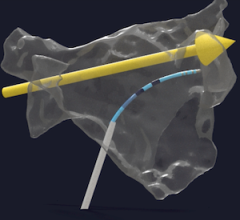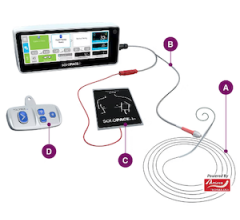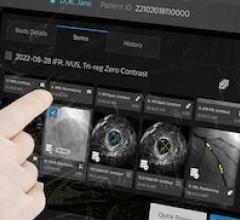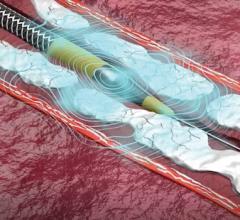
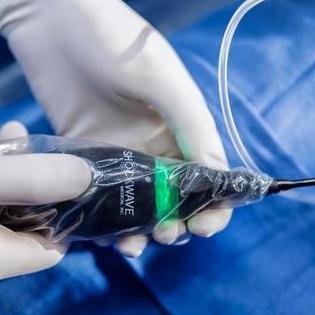
The Shockwave C2 Aero Fly Coronary IVL Catheter delivers pulses at 2 Hz, cutting IVL treatment time in half. Photo: Johnson & Johnson
Oct. 20, 2026 — Johnson & Johnson has announced the U.S. launch of its Shockwave C2 Aero Fly Coronary IVL catheter designed to treat a broad range of calcified coronary artery lesions in half the time as previous coronary IVL devices.1 Leveraging Shockwave IVL’s differentiated mechanism of action, and building on improvements delivered in the Shockwave C2 Aero platform, this next-generation coronary IVL catheter delivers pulses at double the speed and decreases pause time between pulsing cycles by half, while maintaining the safety and effectiveness of prior-generation catheters.1,3,4
“Shockwave C2 Aero Fly is built for the future of coronary interventions, where physicians need proven technologies that can help them move faster without compromising safety or confidence in challenging calcified cases,” said Mike Lang, Worldwide President, Circulatory Restoration, MedTech, Johnson & Johnson. “As the pioneer and leader of the category, Johnson & Johnson is giving physicians and patients an increasingly efficient, predictable platform designed to meet the growing demands of complex coronary care.”
Meeting Cath Lab Demand
Coronary artery disease (CAD) is the leading cause of death globally, affecting an estimated 315 million people worldwide and approximately 1 in 20 adults over the age of 20 in the U.S.5,6,7 With the prevalence of cardiovascular diseases expected to rise and coronary interventions among hospitals’ highest-volume procedures, efficiency is critical to ensure cardiac catheterization laboratories and physicians can manage growing procedural volumes.8,9
“In the cath lab, every second matters, especially as we see more complex cases and higher procedure volumes,” said Hector Tamez Aguilar, M.D., Interventional Cardiologist at Piedmont Healthcare in Atlanta, Georgia.10 “By delivering pulses twice as fast and decreasing pause time between cycles, Shockwave C2 Aero Fly enables faster workflows, helping physicians treat calcified coronary disease more efficiently while meeting the growing pace and demand of cath labs.”
Catheter is Designed to Treat Calcified Coronary Disease
Shockwave C2 Aero Fly enables physicians to treat complex calcified coronary disease faster while enhancing the patient treatment experience through:
-
Faster pulsing: Pulses are delivered at 2 Hz to cut treatment time in half, 115 seconds versus 230 seconds with previous generations of IVL. 1
-
Shorter pause time: Pause time between pulsing cycles is cut to five seconds, shortening wait times between cycles by 50%. 1
-
Reduced patient ischemic time: Lowered balloon inflation time minimizes temporary procedure-related blood flow blockage and patient ischemic symptoms, such as chest pain. 2
-
Leading deliverability, crossability and repositioning capabilities: Builds on Shockwave C2 Aero’s best-in-class features. 3
“During IVL treatment, balloon inflation temporarily blocks blood flow, and that time matters for patient care,” said Karim Al-Azizi, M.D., Medical Director, Structural Heart Program and Cardiac Catheterization Laboratories at Baylor Scott & White Health, Plano, Texas.11 “Shockwave C2 Aero Fly raises the bar for coronary interventions by making procedures easier for physicians and less strenuous for patients. Its shorter balloon inflation and pause time reduce ischemic time and related symptoms for patients, enabling better, quicker and more streamlined care.”
Shockwave C2 Aero Fly catheter is now available in the U.S. The next-generation coronary IVL technology will be featured in the Circulatory Restoration booth from Johnson & Johnson MedTech at TCT 2026, which is taking place in San Diego, California from October 31-November 3, 2026.
-
As compared to Shockwave C2+/Shockwave C2 Aero. Treatment time includes pulsing time and pause time. Pause time may vary by patient need.
-
A shorter inflation time exposes the patient to less ischemic time compared to prior Shockwave devices.
-
Compared to Shockwave C2+ in simulated use bench testing. Based on feedback from physicians who participated in the Limited Market Release Survey. Bench testing not necessarily being indicative of clinical outcomes.
-
Davies RE, Shlofmitz RA, Kim M, et al. Safety and Effectiveness of a Novel 2Hz Coronary IVL System: The Disrupt CAD Duo IDE Study. JACC Cardiovasc Interv. 2026 Mar 7:S1936-8798(26)00777-6. doi: 10.1016/j.jcin.2026.02.018.
-
Centers for Disease Control and Prevention. About Coronary Artery Disease (CAD). www.cdc.gov/heart-disease/about/coronary-artery-disease.html. Last Accessed: March 24, 2025.
-
Centers for Disease Control and Prevention. Heart Disease Facts. www.cdc.gov/heart-disease/data-research/facts-stats/index.html. Last Accessed: March 24, 2025.
-
T S Vijfvinkel, B Nikookar, J Constandse, B H W Hendriks, M Van Der Elst, J J Van Den Dobbelsteen, Medical Process Engineering, Time is muscle: measuring workflow and procedure duration in the catheterization laboratory, European Heart Journal, Volume 44, Issue Supplement_2, November 2023. https://academic.oup.com/eurheartj/article/44/Supplement_2/ehad655.2947/7390764
-
Bruckel J, Lee A, Boudoulas KD. Strategies for Cost-Effective Care in the Cath Lab. Society for Cardiovascular Angiography & Interventions. Published March 16, 2023. Accessed August 7, 2026. www.scai.org/quality-improvement-tools/qi-tips/strategies-cost-effective-care-cath-lab
-
Dr. Hector Tamez Aguilar is a paid consultant for Shockwave Medical. He has not been compensated in connection with this press release.
-
Dr. Karim Al-Azizi is a paid consultant for Shockwave Medical. He has not been compensated in connection with this press release.


 August 28, 2026