November 14, 2019 — There were positive results in the TANGO Trial is a phase 2, dose escalation, double-blinded trial comparing the delivery of temsirolimus to saline control in patients with severe claudication or critical limb ischemia. This is the first United States trial to investigate a sirolimus analog to improve the durability of peripheral revascularization procedures. The purpose of the trial is to limit neointimal hyperplastic tissue growth into the artery after endovascular below-the-knee (BTK) revascularization procedures, where paclitaxel-coated balloons have had limited success. The one-year results were presented at the 2019 Vascular Interventional Advances (VIVA) annual meeting.
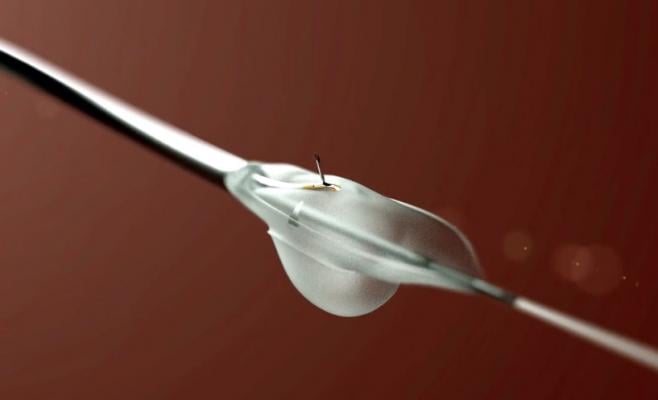
Results are now available comparing Bullfrog micro-infusion device (Mercator MedSystems) delivery of either low-dose temsirolimus treatment (0.1 mg/mL; n = 20) or saline control (n = 20) into the perivascular tissue around lesions subsequent to revascularization. Patients (Rutherford category 3-5) with up to 30-cm–long BTK lesions were enrolled in the study.
The primary safety endpoint was 30-day freedom from major adverse limb event or postoperative death, and no events were observed. The primary efficacy endpoint was improvement in 6-month transverse view vessel area loss (TVAL), an angiographic measure that uses the opacified area of the lesion to approximate the neointimal volume.
At six months, excluding subjects with unstented severe dissections in their target lesion, TVAL improved to 19% in treatment subjects compared to 38% in controls, said Ehrin Armstrong, M.D., director, interventional cardiology VA Eastern Colorado Healthcare System, and co-director, vascular laboratory VA Eastern Colorado Healthcare System, who presented the data.
With respect to secondary endpoints, 6-month freedom from target lesion failure was reported in 58% (11/19) of treatment subjects compared to 42% (8/19) of controls, favoring treatment by a relative 38%. In patients with total occlusions at baseline, 78% (7/9) of treatment subjects and 25% (2/8) of control subjects were free from reocclusion at 6 months. In treatment subjects with wounds upon enrollment or who developed wounds on their target limb during the study, 71% (5/7) of treatment subjects had full healing of wounds by 12 months without the need for clinically driven target lesion revascularization, whereas 44% (4/9) of control subjects had wound healing without prior clinically driven target lesion revascularization.
Find information on all the VIVA 2019 Late-breaking Clinical Trials

 November 03, 2026