News | Stents Peripheral | June 10, 2015

Biotronik Pulsar-18 Self-Expanding Stent Effective in Treating Advanced Superficial Femoral Artery Disease

Investigator-initiated registry reveals 4 French interventions are effective and safe even for long, occluded femoropopliteal lesions and vascular intervention

Biotronik, Pulsar-18, Michael Lichtenberg, study

June 10, 2015 - Biotronik announced the publication of promising clinical results regarding its Pulsar-18 peripheral stent platform. Adding to the similarly encouraging data collected in the earlier 4EVER and PEACE trials, the new results - published in Clinical Medical Insights: Cardiology - further confirm the safety and efficacy of the Pulsar-18 self-expanding nitinol stent, with positive patency results for very challenging cases of femoropopliteal disease.

"The aim of the study was to verify patency results for the Pulsar-18 stent system in routine clinical treatment of long, occlusive femoropopliteal lesions," commented lead investigator Michael Lichtenberg, M.D., Vascular Center Clinic, Arnsberg, Germany. "Even confronting these difficult cases, Pulsar-18's 4 French system yielded strong primary patency."

The investigator-initiated trial was a two center, all-comers, prospective registry that enrolled 36 patients with symptomatic femoropopliteal lesions. The average lesion length was 18.2 cm and all lesions treated were TASC D, both indicative of a very advanced disease state. Additionally, more than 95 percent of the lesions were occlusions. All patients underwent a revascularization procedure with implantation of the Pulsar-18 stent. At 12 months from implantation the overall primary patency rate was 85.4 percent and the freedom from target lesion revascularization (fTLR) rate was 87.5 percent.

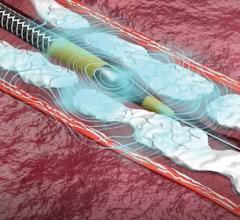
Pulsar stents feature an innovative, highly flexible design coated with proBIO, a silicon carbide layer that improves the stent's hemocompatibility and biocompatibility, which is believed to contribute to its excellent clinical results. Pulsar-18 is available in diameters of 4 to 7 mm and lengths of 20 to 200 mm, all deliverable through a 4 French sheath.

For more information: www.biotronik.com


Related Content

Feature | Cath Lab | Kyle Hardner

Since receiving FDA approval in 2016, intravascular lithotripsy (IVL) systems have grown in popularity among ...

Home November 14, 2025
Home
News | Cath Lab

Nov. 11, 2025 — FastWave Medical has successfully completed enrollment in its 30-patient coronary feasibility study and ...

Home November 13, 2025
Home
News | Cath Lab

Oct. 28, 2025 — Results from the first-of-its-kind randomized PROCTOR trial found that a strategy of saphenous vein ...

Home November 04, 2025
Home
News | Cath Lab

Oct. 27, 2025 — Results from the PREVUE-VALVE study suggest that there are currently at least 4.7 million people aged 65 ...

Home October 29, 2025
Home
News | Cath Lab

Oct. 25, 2025 — Medtronic plc has announced the launch of the Stedi Extra Support guidewire, designed to enhance ...

Home October 28, 2025
Home
News | Cath Lab

Oct. 27, 2025 — Elixir Medical, a developer of technologies to treat cardiovascular disease, has announced new clinical ...

Home October 28, 2025
Home
News | Cath Lab

Oct. 22, 2025 — Heartflow, Inc. has introduced Heartflow PCI Navigator, the newest addition to the Heartflow One ...

Home October 23, 2025
Home
News | Cath Lab

Oct. 15, 2025 — Stereotaxis recently announced it has obtained CE Mark in Europe and submitted a 510(k) application to ...

Home October 16, 2025
Home
News | Cath Lab

Oct. 7, 2025 — Medtronic has announced the full distribution of the Neuroguard IEP System (Neuroguard) after a ...

Home October 07, 2025
Home
News | Cath Lab

Sept. 22, 2025 — Nicklaus Children's Heart Institute in Miami, Florida, is now offering bedside transcatheter patent ...

Home September 23, 2025
Home
Subscribe Now