May 8, 2018 — One-year results from the Sentinel Cerebral Protection System show it can reduce the incidence of stroke during transcatheter aortic valve replacement (TAVR) by more than 60 percent. Since its clearance by the U.S. Food and Drug Administration (FDA) a year ago, the technology is now used by more than 10 percent of TAVR centers nationwide, according to manufacturer Claret Medical.
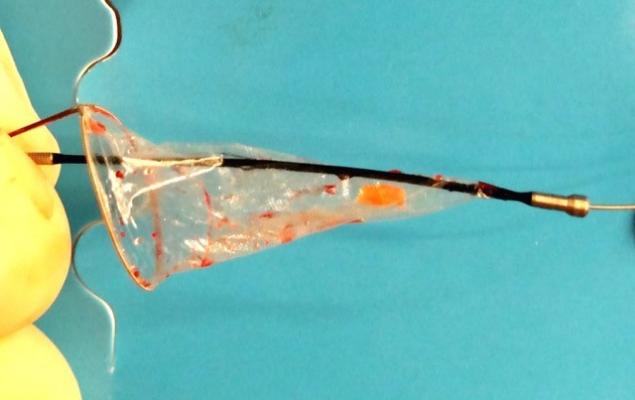
The Sentinel Cerebral Protection System protects patients by filtering, capturing and removing pieces of tissue, calcium and other harmful debris released during TAVR before it can reach the brain. Such debris could cause a blockage, potentially leading to a stroke. Studies have shown that the Sentinel technology captures debris in 99 percent of patients undergoing TAVR and has no safety risks associated with it.
Sentinel patient Jim McCutchon of Corpus Christi, Texas said, “Having aortic stenosis is like flirting with sudden death. My aortic valve was closing down slowly, and I had to stop to catch my breath even with no greater exercise than a leisurely walk. I needed TAVR, but I was concerned that I would have a stroke if I had TAVR without cerebral protection. I struggled with a three-year wait until Sentinel was available, and then I felt confident to move forward with the procedure. I’ve seen pictures of the debris that Sentinel captured on the way to my brain, and I am thankful that I waited. Since then, I have had no problems, and I can run and play again.”
“We would never drive a car without a seatbelt and we should never do TAVR without embolic protection,” said Susheel Kodali, M.D., from New York-Presbyterian Hospital.
“Stroke destroys lives, and it is important that we as physicians do all we can to prevent it. With this in mind, we now use Sentinel technology in all our TAVR cases and have been able to provide greater brain protection to patients,” said Samir Kapadia, M.D., with the Cleveland Clinic.
For more information: www.claretmedical.com

 August 28, 2026