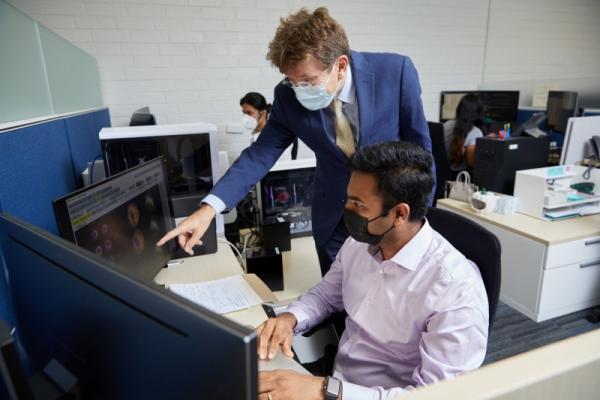
Piotr Slomka, PhD, standing, collaborates with Aakash Shanbhag, MS, a programmer and analyst in the Slomka Lab at Cedars-Sinai. Photo by Cedars-Sinai.
May 4, 2023 — What if you could predict if-or when-your patient might experience a heart attack, cardiac arrest or another heart-related problem?
Investigators are one step closer to achieving this breakthrough in preventive healthcare and offering patients personalized predictions of their heart health thanks to a novel deep-learning tool and artificial intelligence (AI) algorithm developed at Cedars-Sinai.
Investigators say their findings, published today in the peer-reviewed journal NPJ Digital Medicine, might be an effective way to engage patients in their own healthcare.
"Using a specific type of AI trained to interpret images of the heart and developed at Cedars-Sinai, we could both predict the chance of cardiac events-like death, heart attack, or the need for urgent treatment of the heart vessels-and show how the likelihood of these adverse events changes over time," said Piotr Slomka, PhD, director of Innovation in Imaging at Cedars-Sinai and a research scientist in the Division of Artificial Intelligence in Medicine and the Smidt Heart Institute.
To do this, the AI tool was trained to collect and interrogate basic clinical data like each patient’s age, gender, weight, heart rate, and blood pressure, as well as to interpret images of the heart that show blood flow to the heart muscle, and how the heart expands and contracts.
"This general patient data, together with heart imaging, is what the deep-learning platform uses to make cardiac health predictions," said Slomka, senior author of the study.
The predictions are produced in a graph format that indicates individual risk for patient death, heart attack, or requirement for an invasive cardiovascular intervention-such as a stent or bypass surgery-over the period of several years. Slomka says the graphs are simple to understand and can be reviewed by both medical professionals and patients.
"Doctors and patients can use these graphs to track how risk changes over time and to identify individual risk factors," said Slomka. "They can also interactively modify certain risk factors to see how it impacts a patient’s particular risk."
Conceptually, this novel research could have broad implications, says Sumeet Chugh, MD, director of the Division of Artificial Intelligence in Medicine and the Pauline and Harold Price Chair in Cardiac Electrophysiology Research.
"AI algorithms of this nature could enable physicians to communicate more personalized information regarding potential timing of imminent heart disease events, allowing patients to engage more meaningfully in the shared decision-making process," said Chugh, director of the Center for Cardiac Arrest Prevention in the Smidt Heart Institute. "Even more importantly, this tool has the potential to lend data-led, appropriate urgency to heart disease prevention efforts by both patients and providers."
Slomka and his team of investigators plan to test these tools in clinical trials at Cedars-Sinai in the near future.
"Our ultimate goal is to offer such interactive tools online if images and clinical data are uploaded," said Slomka.
For more information: https://www.cedars-sinai.org/
 September 11, 2026