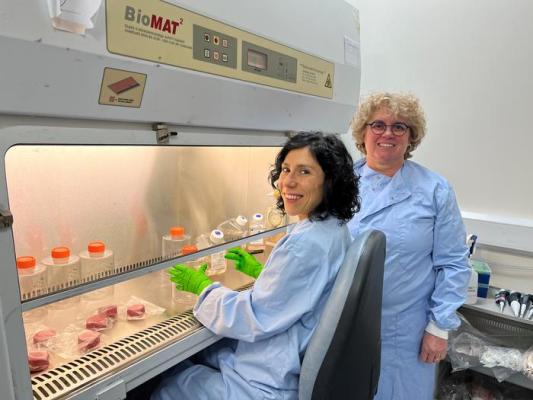
Dr Beatriz Romartinez-Alonso (left) and Dr Louise Fairall. Image courtesy of University of Leicester
November 15, 2023 — Researchers at the University of Leicester have discovered the mechanism by which cholesterol in our diet is absorbed into our cells.
This discovery, which has just been published in the journal Science opens up new opportunities for therapeutic intervention to control cholesterol uptake that could complement other therapies and potentially save lives.
The research, conducted with colleagues from the USA, China and Australia, has shown that two proteins (called Aster B and Aster C) play a key role in transporting cholesterol from the membrane of the cells lining our intestine to the internal compartment where it is modified prior to circulation.
Funding came from the Leducq Foundation which awarded $6 million to eight laboratories across the USA and Europe for collaborative research into how cholesterol is transported in our bodies.
University of Leicester researchers from the Institute of Structural and Chemical Biology, used their expertise to reveal how Ezetimibe, a cholesterol lowering drug, blocks the ability of Aster B and C to transport cholesterol.
Professor John Schwabe, Director of the Institute for Structural and Chemical Biology, said: “This breakthrough is the result of a long-lasting collaboration and forms part of an international effort to identify ways in which we can combat cardiovascular disease and stroke. A better understanding of important areas of cholesterol absorption and metabolism and, particularly, how cholesterol moves within cells and tissues is essential. This knowledge will allow us to design new drugs and therapies that target specific proteins involved in these pathways to combat most pressing public health problems such as heart attacks and stroke.
Cholesterol is a natural fatty substance found in the blood. Produced in the liver, it is also found in some of the foods we eat such as red meat and dairy products. Frying our food can also add to cholesterol in our diet.
Although we need cholesterol in our bodies to function, having too much (high cholesterol) can clog our arteries and cause health problems such as heart disease.
Professor Schwabe added: “If we can prevent some cholesterol from being absorbed into our cells, we may ultimately be able to prevent individuals from having high cholesterol and cut down their risks of heart attack and stroke and therefore potentially save lives.
“The Leducq team of experts have different expertise that is used to target the problem at different levels and following different approaches. In addition to target cholesterol absorption, we are trying to identify how cholesterol metabolism and transport affect cholesterol levels and atherosclerotic disease. Cholesterol transporters are essential to regulate blood cholesterol levels therefore we are testing small molecules that influence the function of these transporters in order to develop drugs that ultimately lower the risk for heart attack and stroke.”
Postdoctoral Researcher, Dr Beatriz Romartinez-Alonso, added: “This has been a great project to work on - discovering new science highly relevant to human health.”
For more information: https://le.ac.uk/
 September 11, 2026