Getty Images
May 19, 2022 — Initial findings from the Distal versus Proximal Radial Artery Access for Cardiac Catheterization and Intervention (DIPRA) study were presented today as late-breaking clinical research at the Society for Cardiovascular Angiography & Interventions (SCAI) 2022 Scientific Sessions. The single center, randomized-controlled trial evaluated outcomes of hand function and effectiveness of conventional proximal radial artery (PRA) access compared to distal radial artery (DRA) access for cardiac catheterization.
Current guidelines for patients undergoing percutaneous intervention recommend PRA access. A complication of PRA is radial artery occlusion, or a blocking of the vessel, which can compromise the access of artery for future coronary bypass surgery, dialysis or other cardiovascular procedures. DRA has the potential to preserve the radial access but little is known of the potential detrimental effects on hand function due to the close proximity to the radial nerve.
In the DIPRA study 300 patients were randomized 1:1 to undergo cardiac catheterization through the DRA or PRA. The primary endpoint was change in hand function from baseline at 30 days and one year. Hand function was a composite of the QuickDASH questionnaire, hand grip test and pinch test. Secondary endpoints included access feasibility, radial artery patency and complications.
Of the 251 patients who completed their 30 day follow up,126 were randomized to DRA and 125 to PRA. Both groups had similar rates of access site bleeding (DRA 0% vs PRA 1.4%). Radial artery occlusion occurred in two patients in the PRA vs none in the DRA. There was no significant difference in the change of hand function in the catheterization hand, in hand grip (DRA -0 [ IQR-3, 3.3 IQR] vs PRA 0 [ IQR-2.7, 3.8] kg), pinch grip (DRA -0.3[IQR-1.2, 0.5] vs PRA 0 [IQR-0.9, 0.9] kg) and QuickDASH (DRA 0 [IQR-4.6, 2.3] vs PRA 0 [IQR-4.6, 2.3] points).There was no significant difference in the composite of hand function between PRA and DRA.
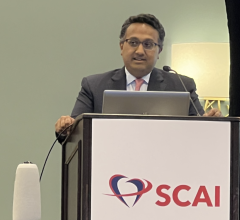
“Recently, we’ve seen growing interest in the distal artery as a unique access for cardiac catheterization,” said Karim Al-Azizi, MD, FSCAI, Interventional Cardiologist at Baylor Scott & White Health- The Heart Hospital in Plano, Texas and lead author of the study. “This study serves as reassurance for physicians that should we choose distal radial access over proximal access, it is safe at 30 days and provides minimal risk to hand function.”
Researchers note data is being collected out to one-year to evaluate the safety of DRA on hand function and anticipate sharing results in 2023.
Sessions Details:
“Distal versus Proximal Radial Artery Access for Cardiac Catheterization and Intervention: 30-day outcomes of The DIPRA study.” [May 19, 2022, 8:15 – 9:30 AM ET, Centennial I, Ballroom Level - LL1]
For more information: https://scai.org/scai2022

 April 24, 2026