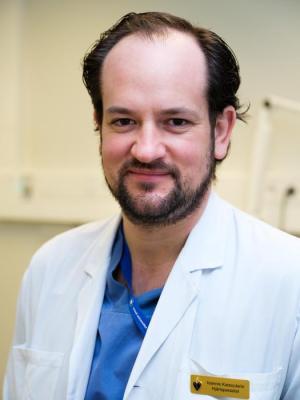
Ioannis Katsoularis, image courtesy of Klas Sjöberg
December 14, 2023 — Individuals infected with COVID-19 are also at an increased risk of suffering from heart rhythm disturbances, such as atrial fibrillation. This is shown in a new study at Umeå University, Sweden, which is one of the largest studies of its kind in the world.
"The results underline the importance of both being vaccinated against COVID-19 and that the healthcare system identifies people at increased risk of this type of complications, so that the correct diagnosis is made and appropriate treatment is started in time," says Ioannis Katsoularis, first author of the study and cardiologist at University Hospital of Northern Sweden in Umeå.
The researchers were able to show that those who had been ill with COVID-19 could also suffer from heart rhythm disturbances, both in the form of so-called tachycardias, when the heart ha rate is high, and bradyarrhythmias, when the heart is slow so that a pacemaker is sometimes needed.
The study shows that the risk of atrial fibrillation and flutter was increased up to two months after infection. In the first month, the risk was twelve times greater than for people who did not suffer from COVID-19 infection.
Even the risk of a specific subset of tachycardias, paroxysmal supraventricular tachycardias was elevated up to 6 months after the infection and was five times greater in the first month. For the bradyarrhythmias, the risk was increased up to 14 days after the infection and was three times greater in the first month compared to subjects without COVID-19. Previous research in this area had not focused as much on which individuals are most at risk.
“We found that the risks were higher in older individuals, individuals with severe COVID-19 and during the first wave of the pandemic. We could also see that unvaccinated people were at higher risk than vaccinated people. Overall, the severity of the infection was the strongest risk factor," says Anne-Marie Fors Connolly, who leads the research group at Umeå University that is behind the study.
In the study, information from large national registers was cross-checked. All people who tested positive for the virus in Sweden from the start of the pandemic until May 2021 were included, but also a comparison group of individuals without a positive test for the virus. Over one million individuals with COVID-19 and over four million control individuals were included in this nationwide study, which is one of the largest of its kind in the world. Researchers at Umeå University have previously shown that COVID-19 leads to an increased risk of blood clots, myocardial infarction and stroke.
For more information: https://www.umu.se/en/
RELATED LONG-COVID COVERAGE:
ACC23 Study Finds Long COVID More Than Doubles Risk of Developing New Cardiac Symptoms
ACC Scientific Session 2023 to Feature Smidt Heart Institute Experts
MRI Sheds Light on COVID Vaccine-Associated Heart Muscle Injury
What We Know About Cardiac Long-COVID Two Years Into the Pandemic
VIDEO: Long-term Cardiac Impacts of COVID-19 Two Years Into The Pandemic — Interview with Aaron Baggish, M.D.
VIDEO: Long-COVID Presentations in Cardiology at Beaumont Hospital — Interview with Justin Trivax, M.D.
VIDEO: Cardiac Presentations in COVID Long-haulers at Cedars-Sinai Hospital — Interview with Siddharth Singh, M.D.

 August 26, 2026