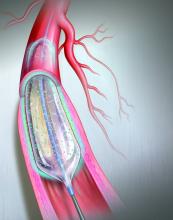
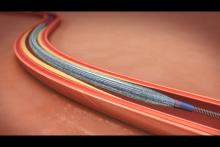
Drug-eluting balloons (DEBs) have been one of the long-awaited new transcatheter technologies to help reduce high restenosis rates in peripheral artery disease (PAD). The U.S. Food and Drug Administration (FDA) cleared C. R. Bard’s Lutonix 035 DEB in November 2014 and Medtronic’s In.Pact Admiral DEB in January 2015. Both are indicated for use in the superficial femoral and popliteal arteries in the upper leg.


At the SPIE Medical Imaging Conference,  ContextVision exhibited results from research conducted in collaboration with Texas Instruments and High Performance Consulting on 3-D adaptive filtering for improved image quality on portable medical devices. Björn Norell, research scientist at ContextVision, presented the findings.

Calgary Scientific Inc. announced the release of ResolutionMD 5.0, which offers better access to health information, supports increased teamwork and enhances communication among practitioners and patients.

Looking to “bypass the ordinary,” during last week’s episode titled: “The Bed's Too Big Without You,” the Grey’s Anatomy team at Seattle Grace Hospital was challenged with treating a radical tumor in the chest. After printing a 3-D model of the surgical area, Dr. Alex Karev commented that the best course of action to access the chest and successfully remove the mass would involve “the McGinn technique.”


iRhythm Technologies Inc. announced the study, “Cost Analysis and Clinical Outcomes of Ambulatory Care Monitoring in Medicare Patients,” was published in the Journal of Health Economics and Outcomes Research. The study assessed the costs incurred in the diagnosis, additional monitoring and following clinical events after the initial use of the Holter monitor among Medicare patients with arrhythmia.


Cerner Corp. and development partner Mortara Instrument have joined together to introduce CareAware Waveform Management. The system displays waveforms and other physiological data from patient monitoring systems and integrates them into the electronic health record (EHR).


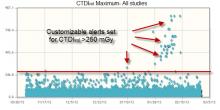
Cardiac imaging accounts for about one-third of the source of X-ray radiation dose for all medical imaging. Expanding use of computed tomography (CT) for cardiac evaluations, use of nuclear imaging for myocardial perfusion exams and more complex transcatheter procedures in the cath lab have all increased patient exposure in recent years. 


Subscribe Now