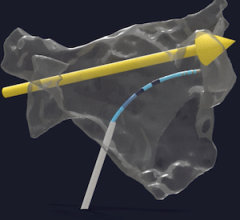
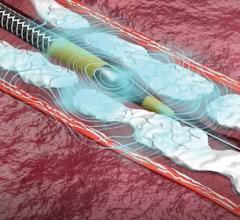
A 3-D OCT rendering of a stented vessel segment created on St. Jude Medical's Ilumien Optis OCT system.
While angiographic X-ray fluoroscopy systems are the workhorse for transcatheter cardiovascular interventional procedures, the technology has several limitations that may impact not only procedural guidance, but also patient outcomes. When there is a clinical question that angiography alone cannot answer, that is when intravascular imaging techniques such as Intravascular ultrasound (IVUS), optical coherence tomography (OCT) or rotational angiography should be used.
Ziad Ali, M.D., associate director of translational medicine, Columbia University Medical Center / New York-Presbyterian Hospital, explained the limitations of angiography at the 2015 Transcatheter Cardiovascular Therapeutics (TCT) annual meeting.
He said angiography limitations include:
1. Cannot determine plaque composition or presence of thin cap fibrous atheromas
2. Cannot image plaque ruptures
3. Cannot image stent malapposition
4. Unable to visualize distal edge of dissections
5. Difficult to visualize mid-segment minimal diameter
6. Difficult to estimate extent of stenosis due to positive remodeling
7. Difficult to properly assess bifurcation lesions due to additional muscle tissue
8. Difficult to do reference vessel sizing
9. Difficult to detect post-PCI complications
10. Difficult to gauge full extent of plaque burden since angiography only shows one 2-D view of a vessel, while OCT and IVUS can offer the entire cross-section of a vessel.
“Ideally it would be great to have a simple tool to do everything, like a Swiss army knife for interventional cardiology, but this is the real world and we don’t have this. So, you need to choose the most appropriate tool for the question you are asking,” Ali said. “The choice of imaging modality is dependent on the type of lesion you are assessing.”
Ali is an advocate for OCT because of its high-resolution image quality, instead of the grainy appearance of lower-resolution IVUS images. “It removes the ambiguity of scrolling through the vessel to look for problems,” he explained.
Watch the video "Advances in Intravascular Imaging at TCT" Ali explains recent advances in IVUS, OCT and FFR. This was a big topic discussed at the 2015 Transcatheter Cardiovascular Therapeutics (TCT) annual meeting.
Navigation Enhanced by Rotational 3-D Angiography
Most of the advanced, premium angiography systems today offer rotational angiography. With this technology, the C-arm makes a quick sweep and is able to use the X-ray volume data to create computed tomography (CT)-like image reconstructions. This allows for the creation of 3-D soft tissue anatomy, which can be overlaid on live fluoro to aid navigation of the cardiac anatomy.
While these 3-D images can aid in navigating catheters in vessels, their greatest benefit may be for navigation during transcatheter structural heart interventions, where it is very important to visualize soft tissue structures that are visible on fluoro.
Related Intravascular Imaging Content:
Find more news on intravascular ultrasound (IVUS)
Find more news on optical coherence tomography (OCT)
Comparison Chart of IVUS Catheters
Comparison Charts for IVUS Systems
IVUS Demonstrates Greater Visualization of Dissections in iDissection Classification Study
VIDEO: Near Infrared Spectroscopy Detects, Aids Risk Assessment of Vulnerable Plaques — Interview with Ron Waksman. M.D.
NIRS-IVUS Imaging Can Help Identify High-Risk Plaques That Can Lead to Adverse Outcomes
IVUS-Guided Drug-Eluting Stent Implantation Improves Clinical Outcomes in All-Comer Patients



 August 28, 2026