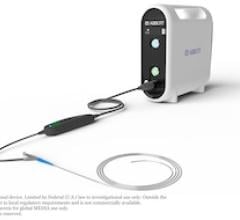
July 26, 2018 — The pivotal clinical study in the U.S. of the Abbott Tendyne Transcatheter Mitral Valve Replacement (TMVR) system has begun. The device is designed for the treatment of mitral regurgitation without the need for open-heart surgery. The trial data will be used for submission to the U.S. Food and Drug Adminsitration (FDA) to seek market clearance.
The SUMMIT Trial will evaluate the safety and efficacy of the treatment in patients suffering from mitral regurgitation (MR). The investigational Tendyne device is the first and only mitral valve replacement that can be repositioned and fully retrieved, allowing the surgeon to precisely place the device during implantation, which could improve patient outcomes.
The study will enroll up to 1,010 patients at 80 sites in the U.S., EU and Canada to evaluate if treatment with the Tendyne TMVR system is safe and effective for patients suffering from severe MR. Jason Rogers, M.D., professor and director of interventional cardiology at U.C. Davis Medical Center in Sacramento, Calif., and Gorav Ailawadi, M.D., professor of surgery and chief of cardiac surgery at the University of Virginia, are co-principal investigators of the study, which will evaluate a composite endpoint of death, cardiovascular hospitalization, stroke or reoperation at one year. The first several patients in the trial were treated at Ascension's Via Christi Hospital St. Francis in Wichita, Kan. and the West Virginia University Heart and Vascular Institute in Morgantown, W.Va.
Since the approval of the MitraClip device in 2008, Abbott has led the development of minimally invasive solutions for difficult-to-treat mitral regurgitation, and the Tendyne device is designed to offer a new treatment option for MR patients requiring a minimally invasive replacement valve.
Mitral regurgitation is a debilitating, progressive and life-threatening disease in which the heart's mitral valve does not close completely, causing blood to flow backward and leak into the left atrium of the heart. The condition can raise the risk of irregular heartbeats and stroke, and if left untreated, could ultimately lead to heart failure and death. Nearly one in 10 people over the age of 75 have moderate to severe MR1, which is often difficult to diagnose. Abbott's MitraClip is the leading approved device to repair a leaking mitral valve, but there are currently no approved minimally invasive therapies to replace the mitral valve.
The Tendyne valve may provide a life-saving treatment option for MR patients by replacing their native mitral valve without open-heart surgery to reduce their heart failure symptoms. The device is a tri-leaflet, bioprosthetic valve available in multiple sizes, and is stabilized by a pad and a tether mechanism that holds the pad in place where it's been implanted inside the native valve. As the first and only repositionable and fully retrievable replacement valve, Tendyne can conform to a broad range of anatomies, which may allow for better outcomes and procedural ease-of-use.
"The mitral valve is known for its complex anatomy and, as a result, managing mitral regurgitation can be challenging, especially in elderly or frail patients for whom there are limited to no treatment options," said Bassem M. Chehab, M.D., medical director of Via Christi's structural heart program, who implanted the first patient in the study with the Tendyne valve. "I'm encouraged by promising early results from the global study and excited about the potential for the Tendyne device to advance the field of transcatheter mitral valve replacement in the U.S. by providing another option for MR patients needing a minimally invasive alternative."
Abbott recently shared data at EuroPCR, the annual meeting of the European Association of Percutaneous Cardiovascular Interventions (EAPCI), that showed positive results from the first 100 patients treated in a global study of the Tendyne device. Results showed that, at 30 days, patients treated with Tendyne had a significant reduction in symptoms of MR and low mortality rates.
"Transcatheter mitral valve replacement represents a new frontier in treating people whose valve does not close properly and who would benefit from a replacement valve instead of repair," said Michael Dale, vice president of Abbott's structural heart business. "Abbott established the market for minimally invasive mitral valve repair with MitraClip, showing the safety and viability of a non-surgical repair and paving the way for other catheter-based devices to treat structural heart diseases. Our scientists and engineers are building on our expertise to advance transcatheter mitral valve replacement with our Tendyne technology to provide a needed treatment option."
In addition to the U.S. pivotal trial, Abbott will initiate a separate feasibility study of the Tendyne system in patients with severe mitral annular calcification (MAC), a condition in which calcium accumulates along and beneath the mitral valve annulus, a ring-like structure that separates the top and bottom chambers of the left side of the heart.
The Tendyne Transcatheter Mitral Valve Replacement system is an investigational device only.
Related Content on the Tendyne Transcatheter Mitral Valve:
Tendyne Transcatheter Mitral Valve Replacement Device Demonstrates Positive 30-Day Outcomes
Minneapolis Heart Institute Continues Early Feasibility Trial With Tendyne Device for Smaller Hearts
Advances and Future Directions for Transcatheter Valves
Abbott Expands Mitral Valve Therapy Offerings With Pair of Transactions
Minneapolis Heart Institute Foundation Conducts First U.S. Implant of TMVR Device
Transcatheter Mitral Valve Replacement Devices in Development
Reference:

 September 02, 2026