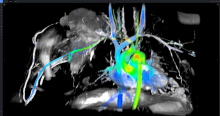
This case study is from the Cardiac Imaging Department, Hospital Clinic, Barcelona, Spain. A woman in her early 60s came to the emergency room with left hemiparesis and her medical history suggested several reasons for concern. She was a sufferer of rheumatic valve disease since childhood and had a history of valve surgeries. They used 3-D echo to clearly identify a small thrombus covering part of the prosthetic ring, which had not been completely clear in the 2-D echo.

GE Healthcare is taking the next leap in image quality performance, quantification and workflow with the introduction of a new generation scanners designed around and built upon GE’s new software-based beamformer platform, cSound. The Vivid S70, Vivid E90 and Vivid E95 systems all are designed around this cSound platform. 

Download the PDF to read more.

On the 100th anniversary of the Endurance expedition to Antarctica led by Sir Ernest Shackleton, doctors writing in the Journal of the Royal Society of Medicine believe the explorer may have had the congenital defect commonly known as a 'hole in the heart'.

Patients enrolled in high-deductible health insurance plans have lower rates of use and lower costs for imaging tests, suggests a study in the February issue of Medical Care.

At the beginning of each year, I always try to determine what the next big cardiovascular technology advances to watch will be in the coming 12 months.  I did not have to look far, as the U.S. Food and Drug Administration (FDA) has pretty much outlined four of these advances with recent meeting notices and approval of a new clinical trial. 

A lengthy review of increasing medical evidence shows that cancer treatments such as chemotherapy and radiation often damage heart vessels and tissues, increasing the risk of later heart disease in cancer survivors. Now an interventional cardiologist from Detroit Medical Center (DMC) who is a co-author of the study is helping efforts to expand a new medical specialty known as “cardioncology.”

The U.S. Food and Drug Administration (FDA) Circulatory System Devices Panel is set to review data and offer recommendations concerning the final approval of Abbott’s Absorb fully bioresorbable stent and the AngelMed Guardian System.

A group of researchers from Russia, Australia and the Netherlands have developed a technology that can reduce magnetic resonance imaging (MRI) scanning times by more than 50 percent.

Bradycardia – a slower than normal heartbeat – does not increase the risk of developing cardiovascular disease, according to a study conducted by researchers at Wake Forest Baptist Medical Center. The study is published in the Jan.19 online edition of the Journal of American Medical Association Internal Medicine.

Subscribe Now