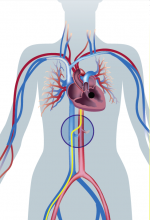
HeartFlow Inc. announced that the National Health Service (NHS) England has chosen the HeartFlow FFRct (fractional flow reserve computed tomography) Analysis as part of the Innovation and Technology Payment (ITP) program. The HeartFlow Analysis was chosen as a new technology to be funded by ITP through a competitive process of nearly 300 applicants. It is the only ITP recipient focused on coronary artery disease (CAD), which affects 2.3 million people in the U.K., according to the British Heart Foundation.

The U.S. Food and Drug Administration (FDA) released a new Medical Device Safety Action Plan outlining how the agency will encourage innovation to improve safety, detect safety risks earlier, and keep doctors and patients better informed.

Nemours Children’s Health System, a Florida-based health system with locations in six states,  is now using in-house medical 3-D printing technology to create surgical models utilizing a U.S. Food and Drug Administration (FDA)-approved segmentation software. The software helps surgeons plan complex multidisciplinary cases in interventional radiology, cancer surgery and cardiac surgery. These models serve as a pre-planning blueprint and roadmap for Nemours surgeons and proceduralists, increasing confidence, reducing procedure times and minimizing unexpected findings while in the operating room.

Men under 50 who smoked were more likely to have a stroke, and their risk increased with the number of cigarettes they smoked, according to new research. The research was published in the American Heart Association’s journal Stroke.

Emerging medical device company Emboline Inc. announced it has completed a Series B funding round totaling over $10 million for its total embolic protection device for transcatheter aortic valve replacement (TAVR) procedures. The funding includes $3 million in new equity financing from multiple investors led by SV Tech Ventures and Shangbay Capital, and over $7 million in conversion of previously-issued convertible notes.


While there is fear by many about the trend of hospitals consolidating into larger healthcare systems, one advantage might be faster matriculation of new cardiovascular technologies from flagship hospitals and academic centers in these networks to smaller community hospitals.  


A 360 degree view of the newest cath lab at Northwestern Medicine Central DuPage Hospital in Winfield, Ill., located in the Chicago suburbs.


Diagnostic and Interventional Cardiology was honored with a pair of Azbee Awards for editorial excellence at the 2018 Upper Midwest Regional banquet in Chicago, hosted by the American Society of Business Publication Editors (ASBPE).


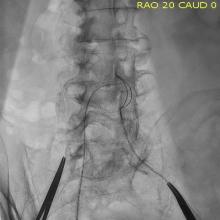
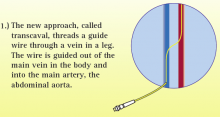
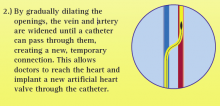
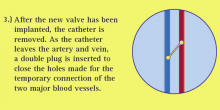
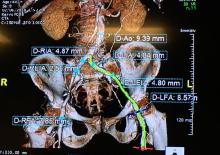
Patient selection for who is best suited for a transcatheter aortic valve replacement (TAVR) procedure is partly based on vascular access routes that can accommodate the large diameter TAVR devices. The femoral access route is considered the best option because it is the most minimally invasive, but some patients will not qualify because of heavy calcification or large lesions in the femoral artery, or popcorn-type calcifications in the aorta.


Many of the world’s leading interventional cardiologists and cardiovascular professionals will convene in San Diego, Calif., April 25-28, 2018, for the Society for Cardiovascular Angiography and Interventions (SCAI) 2018 Scientific Sessions. The annual event will attract nearly 2,000 leading interventionalists and cardiovascular professionals from across the globe for a dynamic four-day program featuring 12 live cases, late-breaking clinical science, case reviews, abstract presentations and interactive workshops.

Subscribe Now